OLED. The very name conjures images of perfect blacks, dazzling colors, and screens so thin they feel almost otherworldly. But for many, the allure of Organic Light-Emitting Diode technology is immediately tempered by a looming question: is the price tag truly justified? Navigating the intricate landscape of OLED pricing and its multifaceted value proposition means weighing breathtaking performance against substantial investment. It's a journey into understanding not just what OLED does, but why it costs what it does, and whether that cost aligns with your specific needs.
At a Glance: Your OLED Decision Cheat Sheet
Before diving deep, here are the core takeaways for understanding OLED's price and value:
- Two Worlds of OLED: We're talking about large-format OLED (TVs, monitors) and Micro OLED (tiny displays for AR/VR). Their cost drivers and value propositions are distinct.
- Perfect Blacks, Infinite Contrast: This is OLED's undisputed champion feature, thanks to self-emissive pixels.
- Premium Price, Premium Performance: Expect to pay more for OLED, especially for larger sizes or cutting-edge Micro OLED.
- Burn-in Risk (TVs): A real, though reduced, concern for static images over long periods.
- Brightness Trade-off (TVs): Often outshined by QLED/Mini-LED in very bright rooms.
- Near-Eye Necessity (Micro OLED): For AR/VR, Micro OLED offers irreplaceable pixel density and speed for immersion.
- Alternatives Exist: QLED and Mini-LED offer strong competition in the TV space, often with better brightness and lower burn-in risk at competitive prices.
- Value is Personal: The "worth" of OLED depends entirely on your viewing environment, content habits, and budget.
The Allure of OLED: What Makes It Special?
Imagine a screen where every single pixel generates its own light. When a pixel needs to be black, it simply turns off completely. This isn't science fiction; it's the fundamental magic behind OLED. Unlike traditional LCDs (Liquid Crystal Displays) that rely on a backlight panel illuminating all pixels simultaneously, OLED’s self-emissive nature allows for what experts call "perfect blacks" and an "infinite contrast ratio." This isn't just marketing jargon; it translates directly into visuals that are breathtakingly rich, with colors that pop and shadows that reveal intricate details without any greyish haze.
This core technological advantage underpins both the cinematic experience of large-format OLED TVs and the immersive realism of cutting-edge Micro OLED displays found in virtual and augmented reality headsets. The ultra-wide viewing angles, ultra-thin form factors, and incredibly fast response times are all direct benefits of this self-emissive design. But as with any groundbreaking technology, such brilliance comes at a cost.
Deconstructing the Price Tag: Why OLED Costs What It Does
The "OLED premium" isn't a single phenomenon; it's a convergence of factors that differ depending on whether you're looking at a 65-inch television or a dime-sized display for a VR headset.
For Large-Format OLED (TVs & Monitors)
When you consider a large OLED TV, its price is influenced by:
- Manufacturing Complexity: Producing large, uniform sheets of organic materials with high pixel density is a delicate and complex process. Any imperfections in the panel can lead to manufacturing waste, impacting overall costs.
- Panel Yield Rates: The percentage of usable panels produced from a manufacturing batch directly affects the final unit cost. While OLED yields have improved dramatically over the years, they can still be more challenging than established LCD production.
- Research & Development Investment: Decades of innovation, material science breakthroughs, and process refinements have gone into making OLED a viable consumer technology. These R&D costs are naturally amortized into the product price.
- Brand Premium & Features: Higher-end OLED TVs often include advanced image processing chips, superior audio systems, and sophisticated smart TV platforms, all contributing to the final retail price. You're not just buying a panel, but a complete entertainment system.
For Micro OLED (AR/VR & Near-Eye Devices)
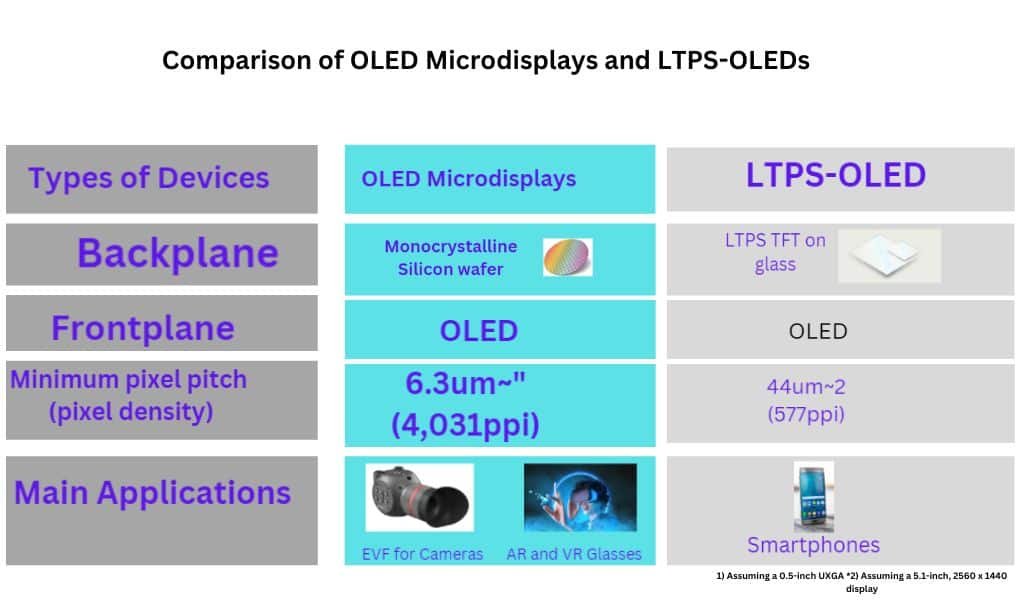
This is where the pricing story takes a very different turn. Micro OLED, often referred to as silicon-based OLED, is less like a traditional display panel and more like an "optical chip." Its cost structure is driven by semiconductor logic, not traditional "per-inch" pricing.
- Silicon Substrate as the Foundation: Instead of glass, Micro OLED pixels are built directly onto a silicon wafer, similar to computer chips. The cost of this substrate, and the complexity of integrating organic light-emitting materials onto it, is a primary driver.
- Exponential Cost with Resolution and Size: Scaling up resolution on a tiny chip—think 2K to 4K on a 1-inch display—demands incredibly precise lithography and manufacturing. Each jump in pixel density or slight increase in chip area dramatically escalates costs and challenges yield rates.
- Extreme Performance Demands: Achieving specifications crucial for immersive AR/VR, such as over 5000 nits brightness, wide color gamuts, true blacks, ultra-high refresh rates, and near-zero latency, requires highly complex designs, specialized materials, and rigorous quality control. These aren't just display components; they're high-performance optical engines.
- Low Current Production Volumes & Custom Engineering: The Micro OLED market is still relatively nascent compared to TVs. Lower production volumes mean less economies of scale. Furthermore, many applications (e.g., military, medical, specific professional AR devices) require custom engineering, driving up unit prices significantly.
Micro OLED Price Spectrum: A Snapshot
| Category | Typical Size | Resolution/Features | Bulk Price Range | Typical Use Cases |
| :------------------------ | :-------------- | :-------------------------------- | :---------------------- | :------------------------------------------- |
| Entry-level | ~0.5 inches | Monochrome/Low-res color | $30-$70 | Industrial viewfinders, basic smart glasses |
| Mainstream Consumer | ~1 inch | 2K resolution, high color brightness | $100-$250 | Key component in high-end AR/VR devices |
| Flagship/Professional | ~1-2 inches+ | 4K+, very high brightness, specialized protection | $300 - Thousands | Military optics, medical imaging, high-performance AR |
This table clearly illustrates that Micro OLED components are significant cost contributors to the final price of devices like AR/VR headsets.
OLED's Value Proposition: Where It Truly Shines
Understanding the cost is one thing; appreciating the value is another. OLED excels in specific scenarios, offering advantages that, for the right user, are simply irreplaceable.
For TVs & Monitors: A Feast for the Senses
- Unparalleled Picture Quality: This is the core appeal. Perfect blacks create a sense of depth and realism that no other widely available display technology can match. Colors appear more vibrant and accurate, making movies, high-quality streaming content, and photo viewing a truly cinematic experience.
- Immersive Viewing: The infinite contrast ratio means even subtle shifts in light and shadow are rendered perfectly, drawing you deeper into the content. Sports broadcasts become more engaging, with crisp motion and vibrant team colors.
- Elegant Design: The self-emissive nature means no bulky backlights are needed. This allows for incredibly thin panels, often just a few millimeters thick, lending a sleek, modern aesthetic to any room.
- Wide Viewing Angles: Unlike many LCD-based panels where color and contrast degrade when viewed off-center, OLED maintains its stunning picture quality from almost any angle, ideal for shared viewing.
- Gaming Prowess: OLED's individual pixel control allows for near-instantaneous response times, eliminating motion blur and ghosting. This, combined with high refresh rates in modern models, offers a significant edge for competitive gamers seeking fluidity and precision.
For Micro OLED (AR/VR & Near-Eye Devices): The Key to Immersion
For augmented and virtual reality, the value of Micro OLED isn't just about premium; it's about being strategically essential.
- Irreplaceable for Near-Eye Applications: The ability to pack extremely high pixel densities onto tiny chips is crucial for creating convincing virtual worlds when the screen is inches from your eye. Traditional AMOLED, while great for phones, lacks the pixel density needed for sharp, immersive near-eye viewing and is hard to miniaturize to such an extent.
- Unrivaled Compactness: Micro OLED panels are miniature marvels, allowing AR/VR headsets to be sleeker, lighter, and more comfortable. This is a critical factor for wider consumer adoption.
- Unprecedented Immersion: The combination of true blacks, high brightness, ultra-high refresh rates, and near-zero latency translates directly into more believable and less fatiguing virtual experiences. This isn't just "good," it's fundamental to preventing simulator sickness and enabling seamless interaction within digital environments.
- Professional & Specialized Use: In fields like military simulation, surgical visualization, or high-performance industrial AR, the precision, clarity, and rapid response of Micro OLED are non-negotiable, justifying its high cost.
While products like the Apple Vision Pro are certainly driving supply chain expansion and will likely lead to gradual price reductions for Micro OLED through increased manufacturing scale and improved yield, this technology will remain a high-value, high-performance component. It represents a strategic investment in delivering the ultimate product experience for near-eye applications.
Weighing the Alternatives: OLED vs. The Competition
Understanding OLED's strengths is only half the battle. To truly grasp its value, you need to see how it stacks up against its closest rivals.
For Large-Format Displays (TVs & Monitors)
Here, the main contenders are QLED and Mini-LED, both evolutions of LCD technology designed to address some of its limitations.
- OLED vs. QLED (Quantum Dot LED):
- QLED Advantages: Generally achieve much higher peak brightness, making them excellent for bright rooms and delivering punchier HDR (High Dynamic Range) highlights. They are also less susceptible to burn-in, making them a safer bet for gamers with static HUDs or news junkies. Often, you can find a larger QLED TV for the same price as a smaller OLED.
- QLED Disadvantages: Because they still rely on a backlight, QLEDs cannot achieve perfect blacks. This can result in some "halo" or "blooming" effects (light bleeding into dark areas) around bright objects on a dark background. Viewing angles, while improved, tend to degrade faster than OLEDs when watched off-center.
- The Takeaway: QLED offers a fantastic, vibrant picture with superb brightness, often at a more accessible price point, particularly for those concerned about burn-in or viewing in bright environments.
- OLED vs. Mini-LED:
- Mini-LED Advantages: This technology uses thousands of tiny LEDs for its backlight, allowing for many more "dimming zones" than traditional LCDs. This results in significantly improved contrast and black levels compared to standard QLED/LCD, getting much closer to OLED's performance. They also offer excellent peak brightness and are virtually immune to burn-in. Pricing can be very competitive with OLED.
- Mini-LED Disadvantages: While much better than standard LCD, Mini-LED still has a backlight, so it cannot achieve the absolute "perfect black" of OLED. Blooming, though significantly reduced, can still be present in extreme scenarios.
- The Takeaway: Mini-LED represents a formidable alternative, especially for those who want near-OLED black levels and contrast, combined with superior brightness and burn-in resistance, often for a similar or slightly lower cost.
Ultimately, Deciding if OLED is worth it often comes down to balancing these trade-offs against your specific priorities.
For Micro OLED (Near-Eye Applications)
In the specialized world of AR/VR, Micro OLED faces different competitors, and its advantages are often about fundamental capability rather than just premium features.
- Micro OLED vs. AMOLED (Active Matrix OLED):
- AMOLED Advantages: Cheaper at larger sizes (think smartphone displays) and offers good contrast.
- AMOLED Disadvantages: Lacks the extreme pixel density required for near-eye applications without a "screen door effect." It's also much harder to miniaturize AMOLED efficiently to the sub-inch sizes needed for compact AR/VR.
- The Takeaway: AMOLED is a great technology for phones and tablets but simply isn't engineered for the demands of high-resolution near-eye immersion.
- Micro OLED vs. Micro LED:
- Micro LED Advantages: Offers even higher brightness and potentially longer lifespan than OLED. It's considered a strong contender for future displays across all sizes.
- Micro LED Disadvantages: Current mass-transfer technology (placing millions of tiny LEDs precisely) is not advanced enough to be cost-competitive or market-ready for widespread consumer adoption, especially at the miniature scale required for AR/VR.
- The Takeaway: Micro LED is the "next big thing" potentially, but it's still largely in the R&D phase and prohibitively expensive for most applications.
- Micro OLED vs. LCD:
- LCD Advantages: Unmatched in price, especially for larger displays.
- LCD Disadvantages: For near-eye applications, LCD falls significantly short in response speed, contrast ratio, and ability to achieve the small form factors needed for comfortable headsets.
- The Takeaway: LCD is a non-starter for high-performance immersive AR/VR due to fundamental technological limitations that compromise the experience.
For near-eye, Micro OLED's premium reflects its ability to deliver an experience that, for now, cannot be replicated by other technologies without significant compromises.
The "Gotchas": Understanding OLED's Limitations
No technology is perfect, and OLED, despite its many virtues, comes with a few considerations that every potential buyer should be aware of.
- The Burn-in Question: This is perhaps the most persistent concern surrounding OLED TVs. Burn-in occurs when static images (like news channel tickers, game HUDs, or channel logos) are displayed for very long periods, causing the pixels in that area to degrade unevenly and leave a faint, permanent "ghost image" on the screen.
- Reality Check: Modern OLED TVs have numerous technologies to mitigate burn-in, including pixel shifting, logo brightness adjustments, and pixel refresh cycles. For most viewers who watch varied content, it's a minimal risk. However, if you primarily watch channels with static logos for many hours daily, or play games with constant HUD elements for extended sessions, the risk is still present. It's a trade-off for the perfect blacks.
- Peak Brightness in Bright Rooms: While OLED offers incredible contrast, its peak brightness generally doesn't reach the scorching levels of top-tier QLED or Mini-LED TVs. In a dimly lit home theater, this isn't an issue; in fact, the deep blacks are paramount. But in a very bright, sun-drenched living room, an OLED might appear less vibrant than a brighter alternative.
- Fragility (Large-Format): OLED panels can be more delicate than their LCD counterparts. They are often incredibly thin, and while well-protected within a TV casing, they can be more susceptible to damage from impacts or mishandling during installation. For families with very young children or pets, this might be a factor to consider.
Is OLED Worth It For You? A Decision Framework
Now that we've dissected the pricing, value, and limitations, let's put it all together to help you make an informed decision. The "worth" of OLED isn't universal; it's deeply personal and depends on your unique circumstances.
- Your Room Environment:
- Dim, controlled lighting (dedicated home theater, living room used mainly at night): OLED will deliver its most stunning performance here. The perfect blacks and infinite contrast truly shine without competing with ambient light.
- Bright, sunlit room (windows, open concept): QLED or Mini-LED might offer a more satisfying viewing experience due to their higher peak brightness, making the picture "pop" more effectively against ambient light.
- Your Viewing Habits & Content:
- Movie buffs, cinephiles, premium streaming enthusiasts: OLED is designed for you. The cinematic quality, color accuracy, and deep blacks will elevate your viewing of high-production content.
- Sports fans: The fast response times and vibrant colors of OLED make live sports incredibly engaging.
- Gamers (varied games): OLED's low input lag and fast response are fantastic.
- Gamers (playing the same game with static HUDs for hundreds of hours): This is where burn-in risk becomes a stronger consideration. QLED or Mini-LED might offer more peace of mind.
- News junkies (same channel, same static ticker): Again, consider the burn-in risk.
- Your Budget:
- Premium Investment: OLED is still positioned as a premium technology, especially for TVs. If you have the budget and prioritize the absolute best picture quality under ideal conditions, it's a justifiable investment.
- Value-Driven: For the same budget, you might be able to get a larger QLED or Mini-LED TV with excellent performance, or one with more features, or simply save some money. If cost-efficiency is paramount, these alternatives offer compelling value.
- Family Needs & Durability:
- Active Households: If you have young children or pets, the slight fragility of OLED panels might be a minor concern. QLED and Mini-LED panels tend to be more robust. Fingerprints also tend to show more easily on OLED screens due to their reflective nature.
- For Near-Eye Applications (AR/VR):
- Seeking the Ultimate Immersion: If you're investing in a high-end AR/VR headset, understanding that Micro OLED is a strategic component is key. Its value is less about "cost vs. alternative" and more about "cost vs. indispensable capability" for delivering a truly compelling and non-fatiguing virtual experience. Here, the premium often directly translates to the quality of immersion.
Common Questions About OLED Value
Is 4K OLED worth it over 1080p?
For large-format TVs, absolutely. 4K resolution provides significantly more detail, especially noticeable on larger screens and when sitting closer. For Micro OLED in AR/VR, 4K (or higher) is almost a necessity, as the display is so close to your eye that even 2K can show individual pixels (the "screen door effect"). Higher resolution is fundamental for immersion in near-eye devices.
Does OLED burn-in still happen?
Yes, it's still possible, but far less common with modern OLED TVs. Manufacturers have implemented sophisticated pixel refresher algorithms and pixel shifting technologies to mitigate the risk significantly. For typical viewing habits with varied content, the risk is very low. However, for extreme, static-image use cases, the risk, while small, remains.
Will OLED prices drop significantly?
For large-format OLED TVs, prices have steadily decreased over the years, making them more accessible than ever. This trend will likely continue, but dramatic, sudden drops are unlikely as manufacturing processes mature. For Micro OLED, prices are high due to low production volumes and complex engineering. As the AR/VR market expands (driven by devices like the Apple Vision Pro), increased scale and improved yields will lead to gradual price reductions, but it will remain a premium component for the foreseeable future.
Is OLED only for high-end users?
While OLED definitely appeals to audiophiles and videophiles due to its superior picture quality, its increasing accessibility means it's no longer exclusively for the ultra-luxury segment. However, it still represents a premium investment compared to many LCD-based options. The value it offers often aligns best with users who prioritize visual fidelity above all else in their entertainment experience.
Making Your Informed Choice: Beyond the Hype
Ultimately, the decision of whether OLED's pricing aligns with its value proposition for you is a personal one. There's no single "best" display technology; there's only the best display for your specific home, your viewing habits, and your budget.
OLED offers an unparalleled visual experience in the right conditions, delivering a level of contrast and color fidelity that can transform how you consume content. For near-eye applications, Micro OLED is a foundational technology driving the next wave of immersive computing.
However, understanding its limitations—the potential for burn-in (for TVs), lower peak brightness compared to rivals, and its premium cost—allows you to weigh these against the strong alternatives like QLED and Mini-LED. These competitors provide excellent picture quality, often with superior brightness and burn-in resistance, potentially offering a better overall value for different use cases.
Arm yourself with this knowledge. Consider your environment, scrutinize your viewing patterns, and assess your budget. By doing so, you can move beyond the hype and make an informed choice that truly enhances your visual experience, ensuring your investment delivers genuine, lasting value.